T Level Health vs BTEC Health and Social Care: Which Is Right for You?
Choosing your next step after GCSEs can feel like a big decision, especially if you’re passionate about helping others. You may have heard about both T Levels in Health and BTEC Health and Social Care qualifications, but what’s the difference? And more importantly, which is right for you?
Both routes can open doors to a rewarding career in healthcare, but the T Level Health qualification is designed for the future. It combines in-depth classroom learning with real industry experience. This helps you step confidently into the world of work or higher education.
In fact, uptake of T Levels is growing quickly: 25,508 learners started T Levels in the 2024–25 academic year. This is a 59% increase from the previous year, showing how more students are choosing this route.
In this blog, we’ll break down how a T Level in Health compares to BTEC Health and Social Care, what makes each unique, and why more students are choosing the Health and Social Care T Level as their modern pathway into healthcare.
What are T Levels?
T Levels are a new type of qualification introduced by the government to give students a clear route into skilled careers. Designed in collaboration with employers, they blend academic learning with hands-on experience. This prepares you for work, apprenticeships, or university.
Each T Level is equivalent to three A Levels. The T Level in Health is tailored specifically for those who want to work in the healthcare sector. This could include nursing, midwifery, healthcare science, or other clinical roles.
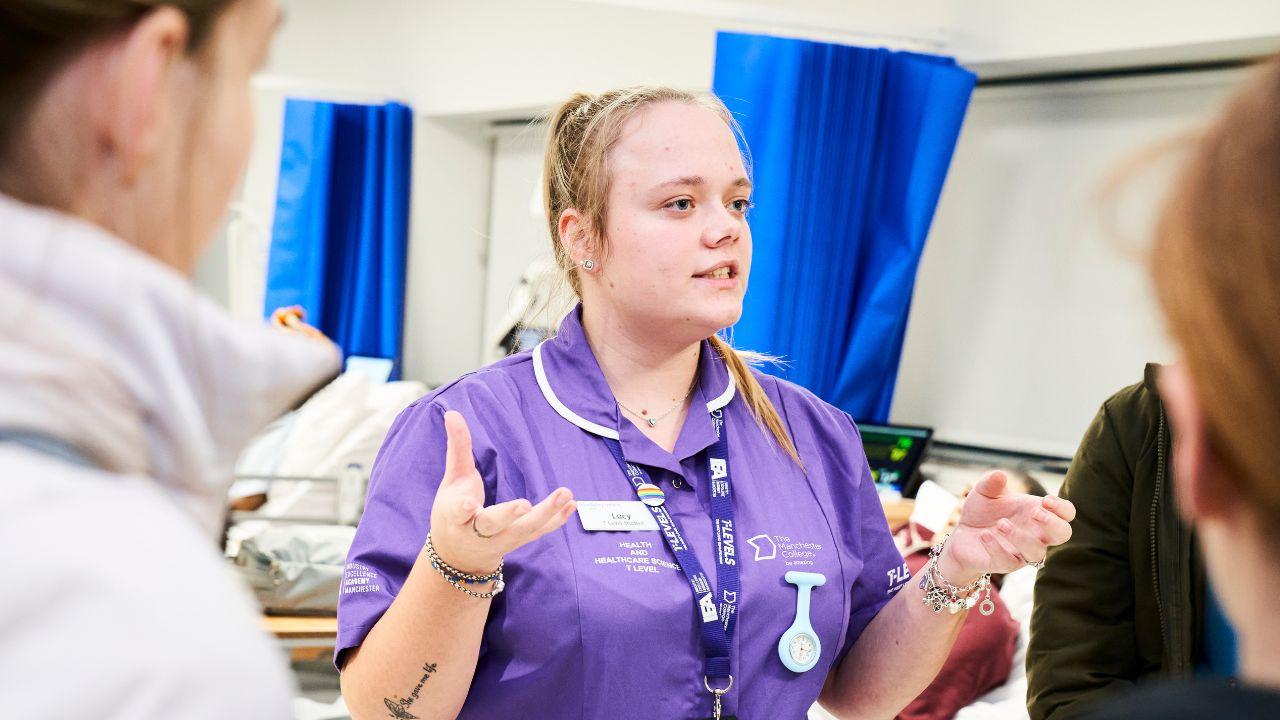
What sets T Levels Health apart is the industry placement: a minimum of 315 hours (around 45 days) spent working with a real employer in the sector. This gives you the opportunity to put your knowledge into practice, develop confidence, and gain a genuine understanding of what a career in health is really like.
Learn more: What Are T Levels?
What is a BTEC in Health and Social Care?
The BTEC Health and Social Care qualification has been a popular choice for many years. It focuses on developing theoretical knowledge about health, care, and early years services, alongside some practical skills. Students complete coursework, projects, and exams, often through case studies and simulated assignments rather than real-world placements.
BTECs are well established, and many students have progressed from them to university degrees or health-related apprenticeships. However, as the health sector evolves, T Levels in Health and Social Care are becoming the preferred choice. Employers who value direct, workplace-based learning are more likely to prefer a T Level.
Comparing a T Level in Health with BTEC Health and Social Care
Let’s take a closer look at how these two qualifications differ.
| Feature | T Level Health | Health BTEC Health and Social Care |
| Qualification Level | Level 3 (equivalent to 3 A Levels) | Level 3 (equivalent to 3 A Levels) |
| Focus | Technical and career-focused, with employer input | Academic and vocational, focused on coursework |
| Assessment | Exams, practical assessments, and employer-based projects | Mainly coursework with some external assessments |
| Industry Placement | Minimum 315 hours with a real employer | Optional or simulated work experience |
| Pathways After | Direct entry into skilled work, higher apprenticeships, or university | Typically, progression to university or further training |
| Learning Style | Mix of classroom theory, lab work, and real-world practice | Classroom-based with case studies and written work |
| Employer Involvement | Designed in collaboration with NHS and industry partners | Limited employer design input |
Both qualifications cover similar areas, like anatomy and physiology, communication in care, and safeguarding. A T Level in Health takes these topics further by connecting them directly to what’s happening in today’s healthcare settings.
Learn more: A Guide to Health and Social Care Courses
Why Choose T Level Health?
The Health and Social Care T Level isn’t just another qualification, it’s a career-launching experience. Here’s why it’s becoming the number one choice for ambitious students.
1. Real experience with real employers
The standout feature of the T Level in Health is its industry placement. You’ll spend a significant amount of time in a healthcare environment, such as a hospital, GP surgery, or community care setting. This experience gives you invaluable insight into the realities of healthcare, such as shadowing professionals to supporting patient care.
By the time you complete your T Level, you’ll already have built practical skills and professional confidence. You’ll also have gained a network of contacts in the industry. That’s something that employers notice.
2. Designed for the future of healthcare
Healthcare is changing fast with new technologies, digital records, and a growing focus on patient-centred care. The T Level Health curriculum has been created in partnership with the NHS and healthcare employers to reflect these developments.
That means you’ll learn modern, up-to-date skills that match what’s needed in today and tomorrow’s healthcare workforce. This will give you a real advantage when applying for jobs or university courses.
3. A strong foundation for your next step
Whether you dream of becoming a nurse, midwife, paramedic, or healthcare assistant, the Health and Social Care T Level gives you a strong foundation.
Many students go on to higher apprenticeships in healthcare or related university degrees. Universities are increasingly recognising T Levels as a robust alternative to A Levels and BTECs because of their blend of academic and practical learning.
4. Learning that brings health to life
Instead of learning purely from textbooks, T Level students explore real healthcare challenges. You might study infection control one week, then observe how those protocols are used on placement the next.
This applied learning approach helps you see the bigger picture. It connects theory to practice, and you’ll gain a good understanding of how your future role can make a difference to people’s lives.
5. Employers trust T Levels
Because T Levels were designed with employers, they carry strong credibility within the healthcare industry. NHS trusts, care providers, and private healthcare organisations are already recognising T Levels as a reliable indicator of a student’s readiness for work.
When you complete your T Level in Health, you’ll have a qualification that says: I have real experience, I understand the demands of the sector, and I’m ready to contribute.
What you’ll study in a T Level Health course
While each college may have its own approach, most T Levels in Health include the following core components:
- Working within the health and science sector
- Human anatomy and physiology
- Health and wellbeing
- Infection prevention and control
- Managing data and patient records
- Safeguarding and equality
- Professional practice and communication
Depending on your chosen specialism, you might focus on different areas such as Supporting the Midwifery Team. Specialist options allow you to tailor your studies to your career goals. This is another big advantage over the broader BTEC Health and Social Care.
Study T Level Health at TMC
It’s clear that both T Levels and BTECs can lead to exciting careers in health and social care. But if you want a qualification that truly reflects the modern world of healthcare, that gives you real experience, real skills, and real confidence, then the T Level in Health is the future-focused choice.
Explore our T Levels Health and Social Care options today and discover how TMC can help you take your next step towards a career that changes lives. Enrol now.